How Do RC Transmitters and Receivers Work: Unlocking the Symphony of Control

I still remember the moment I finally understood what was really happening between my RC transmitters and the little RC receivers tucked inside the chassis. After hours of testing on the bench and a few triumphant range walks at the park, the patterns clicked. The transmitter is your voice, the receiver is the ears and hands, and the vehicle is the dancer.
Every stick nudge becomes a compact radio message; every servo twitch is that message turned into motion. If you are new to the radio side, this radio control guide helped me connect the dots on the basics of signals and channels. In the next sections, we will break down the signal language of the radio control system, show how RC receivers decode it, walk through binding and synchronization, and then try it all on real RC cars, planes, helicopters, and even submarines.
This journey into understanding the RC communication protocol will give you the confidence to take control and enjoy the full potential of your remote-controlled models.
Breaking Down the RC Signal: The Transmitter’s Secret Language
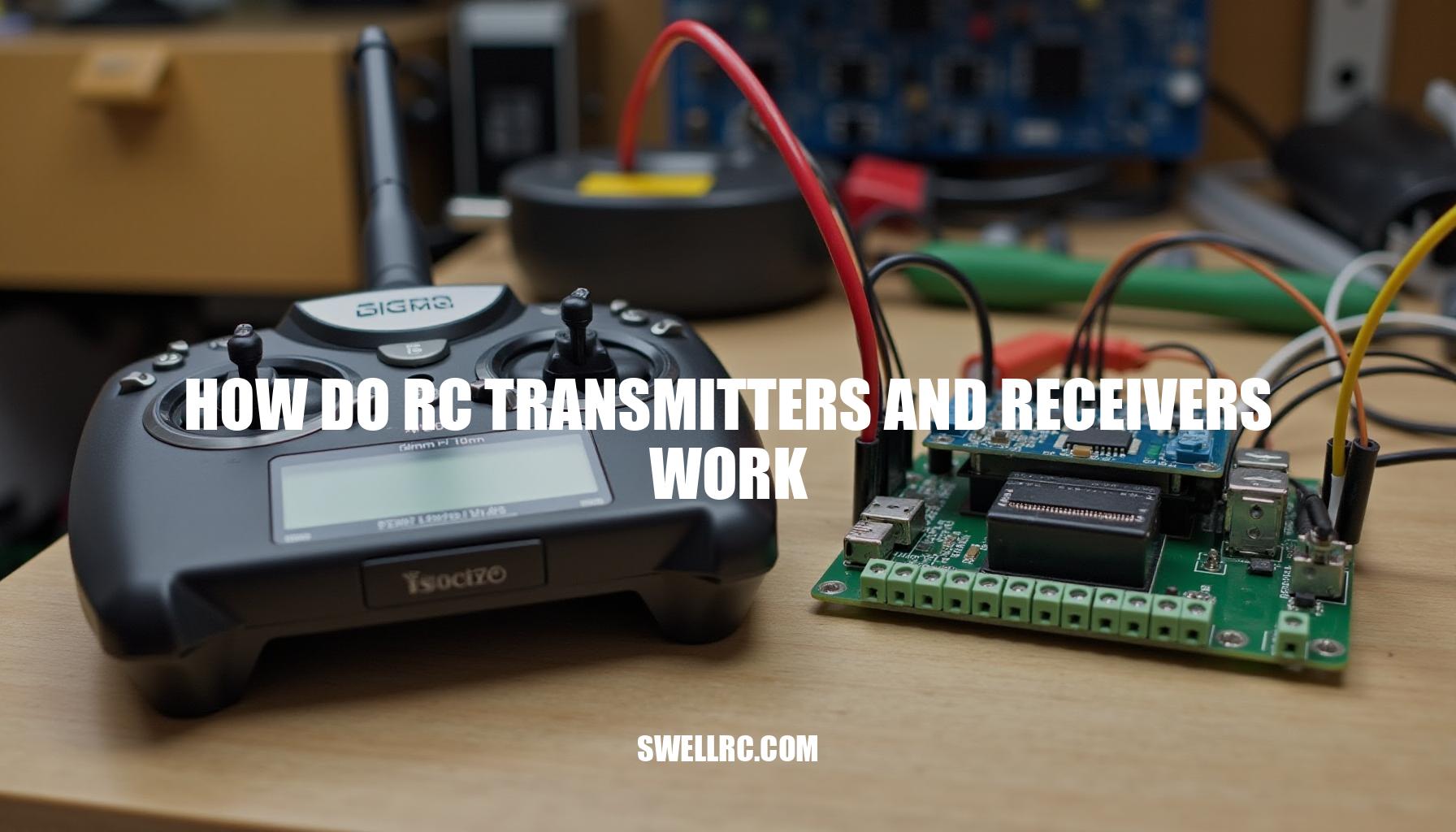
Once I saw the transmitter as a tiny computer with an antenna, everything made sense. The sticks and switches are sampled, mixed, and packed into a radio waveform. Each channel acts like its own conversation line, carrying one control action such as steering, throttle, elevator, or rudder.
Modern RC transmitters mostly use the 2.4GHz frequency band because the antennas are small, the spectrum is globally available in many regions, and digital spread spectrum methods like FHSS or DSSS resist interference effectively. Older AM or FM radios operated at 27, 35, 40, or 72 MHz using quartz crystals to lock onto a single frequency, which could cause conflicts among pilots. In contrast, digital systems employ rapid frequency hopping and error correction, enabling two radios to share the airwaves without stepping on each other’s signals, thanks to advanced RC communication protocol designs.
These principles are consistent across different RC controllers; for a broader primer on the control hardware itself, this overview is handy: https://www.swellrc.com/how-do-rc-controllers-work/.
Here is a small diagram in words, mapping sticks to outputs:
- Right stick left or right controls the steering channel; the receiver outputs PWM to the steering servo.
- Right stick up or down controls the elevator channel; the receiver outputs PWM to the elevator servo.
- Left stick up or down controls the throttle channel; the receiver outputs signal to the ESC or throttle servo.
- Left stick left or right controls the rudder channel; the receiver outputs PWM to the rudder or yaw control.
Practical notes I learned the hard way:
- Latency depends on the specific RC communication protocol and frame rate used by the transmitter and receiver.
- Range is influenced by antenna quality, output power, and environmental factors.
- Multipath reflections from buildings and trees can degrade RC signal quality.
- Nearby Wi-Fi networks or high-power video transmitters can cause RC signal interference if antenna placement and shielding are not properly managed.
The Receiver’s Role: Where Signals Become Motion
Watching a bare RC receiver on the bench is oddly satisfying. The LED indicates link status, the antennas listen, and the microcontroller decodes each packet before outputting clean servo signals. In most setups, each output pin delivers PWM pulses to servos or an ESC.
After I tuned servo endpoints and reversed one channel on my radio, the steering finally centered perfectly; that was the moment the theory became real. Binding and synchronization tie the two ends together so only your receiver listens to your transmitter. If you need the step-by-step, I used this walkthrough to bind cleanly: https://www.swellrc.com/how-to-bind-rc-transmitter-and-receiver/.
PWM made simple: A channel sends repeated pulses about 50 times per second; 1.0 ms is typically minimum, 1.5 ms center, and 2.0 ms maximum.
Digital RC receivers can also carry multiple channels over one wire via protocols like PPM or serial bus types. Robust radios add checksums and frequency hopping to resist noise and reduce dropouts.
Quick troubleshooting tips I keep handy for optimum RC binding process and performance:
- Set antenna tips at 90 degrees for diversity receivers.
- Keep receiver and antennas away from motors, ESCs, and carbon fiber to avoid interference.
- Recalibrate ESC throttle endpoints if the motor behaves oddly.
- Re-bind after firmware updates or when swapping modules to maintain secure links.
- Check for power brownouts; a weak BEC can cause receiver reboots and signal loss.
- Set failsafe positions so the model behaves safely on signal loss or interruption.
Real-World Examples: Cars, Planes, Helicopters, and Submarines
RC cars translate channels into steering via a servo and speed control through an Electronic Speed Controller (ESC). When I synchronized a new car radio, the steering snapped to attention and the throttle became linear instead of jumpy, greatly improving my RC car control experience. For those facing pairing issues, this guide offers a clear sync process.
On the other hand, RC plane control feels like conducting a graceful orchestra — the ailerons roll, the elevator pitches, the rudder yaws, and the throttle sets energy. For beginners, a friendly primer on the essential control surfaces and their interplay can be found here: how an RC plane works. When shopping for a transmitter, the feel and programmability matter tremendously.
I compared several options that helped me choose the perfect radio for fixed-wing flying: best RC plane transmitters.
Helicopter transmitters add complexity with collective pitch, cyclic mixing, and often a flybarless controller to interpret your inputs. Investing in a solid heli radio with reliable curves and switches simplified my setup and reduced the intimidation factor. This shortlist of recommended radios helped me narrow things down: best RC heli transmitter.
RC submarine control is a fascinating edge case. Since high-frequency radio waves struggle to travel underwater, many RC subs use lower frequency signals, tethers, or alternative methods. This deep dive explains the tradeoffs and why positioning is so critical: how do RC submarines work.
Finally, if you want a single handset that can control multiple surface models, considering a universal remote is wise. Check out this guide on universal RC car remotes. Additionally, if you wish to customize channel assignments or throttle curves on your RC car, these programming steps saved me countless hours in the garage.
Troubleshooting and Advanced Insights
The fixes that kept my models reliable came from simple, methodical checks. Here’s a numbered checklist for effective RC troubleshooting to avoid common pitfalls like RC signal interference and to maintain remote control synchronization:
- Do a proper range test with the model on the ground and antennas oriented correctly.
- Inspect antenna tips for damage and keep them above the frame or body shell.
- Separate receiver and antennas from high-current wires and ESCs; add ferrite rings if needed.
- Verify BEC output voltage and current; brownouts cause reboots and jitter.
- Re-bind and recalibrate endpoints after any firmware or module change.
- Update transmitter and receiver firmware to the latest stable version.
- Set failsafe to a safe throttle and neutral controls.
- Use diversity receivers or add a second antenna for better coverage.
- Reduce transmitter output power only for bench work; use legal maximum in the field.
- Log telemetry like RSSI and packet loss so you can spot issues before they become fails.
To better understand the differences in analog vs digital RC transmissions and their impact on model reliability, consider this data-oriented snapshot:
| Aspect | Analog RC (AM/FM) | Digital 2.4GHz RC |
|---|---|---|
| Frequency Bands | Lower MHz bands using fixed crystals | 2.4 GHz with DSSS or FHSS |
| Interference Susceptibility | Prone; requires frequency management at the field | Strong noise resistance via binding, error correction, frequency hopping |
| Channels | Fewer channels available | Higher channel counts |
| Latency | Higher latency | Lower latency |
| Multi-user Operation | More complex due to frequency conflicts | Simpler with automatic frequency hopping and binding |
Exploring new trends like robust long-range options with efficient modulations, bidirectional telemetry for battery and signal health, and advanced mixers helps keep models responsive and reliable. After extensive field tests, especially at my local park, the biggest game changers in maintaining model performance were antenna placement and ensuring consistent power delivery. Once those were solid, both link quality and control feel improved dramatically, underscoring the importance of targeted RC troubleshooting for anyone serious about seamless remote control synchronization.
Conclusion: Unlocking the Symphony of Control
Once I finally understood that every stick movement becomes a tiny radio story and every receiver turns that story into motion, the hobby felt brand new. We covered how RC transmitters create and encode multi-channel signals, how RC receivers decode them into PWM or serial outputs, why the RC binding process protects your link, and how to troubleshoot range, jitter, and dropouts.
The most satisfying part is that you can now experiment with confidence:
- Try a new model memory
- Refine endpoints
- Do a clean range test before that first run or maiden flight
Keep exploring, keep asking why, and you will keep unlocking more of this invisible symphony that powers RC cars, planes, helis, and subs.
Frequently Asked Questions
- What’s the difference between an RC transmitter and a receiver?
The transmitter is the handheld radio that converts your stick and switch inputs into encoded radio signals. The receiver is the onboard unit that listens for those signals, verifies them, and outputs control commands as PWM or serial data to servos, ESCs, and flight controllers. - How does a radio signal control an RC car or plane?
Your inputs are sampled and packed into channel data, then sent over a radio link. The receiver decodes each channel and produces timed pulses for servos and speed controllers. Steering, throttle, aileron, elevator, and rudder each correspond to a channel, so the vehicle moves exactly as the channel values change. - Can any transmitter work with any receiver?
Not universally. The radio and receiver must match frequency band and communication protocol, and many brands use proprietary systems. Some radios support multiprotocol modules or external RF modules that let one transmitter bind to multiple receiver types. A single transmitter can store many model memories and bind to many receivers, but typically you control one model at a time. - How do you sync or bind a new RC transmitter?
Put the receiver into bind mode using its button or bind plug and power it. Put the transmitter into bind mode on the same protocol and region setting. When the receiver indicates a solid link, exit bind mode, set failsafe positions, and power cycle both units. Finally, verify control directions and range test before use. - Why does my RC receiver lose signal?
Common causes include poor antenna orientation, carbon or metal blocking the antennas, electrical noise from ESCs and motors, power brownouts from a weak BEC, or simply flying or driving beyond reliable range. Reposition antennas, ensure solid power delivery, separate noisy components, and use diversity or higher quality receivers to improve reliability. - What frequency is commonly used for RC controls?
Most modern hobby systems use 2.4GHz for compact antennas and robust digital links. Older systems used 27, 35, 40, or 72 MHz, and some long-range setups operate around 868 or 915 MHz depending on region. Always follow your local regulations for allowed frequencies and power levels. - How can I improve the range of my RC transmitter?
Use proper antenna orientation and keep the tips clear of the frame, elevate the model and transmitter for line of sight, choose a diversity receiver, ensure your power system prevents brownouts, and avoid mounting the receiver near high current wires. Within legal limits, choose appropriate output power and protocols designed for long-range links.