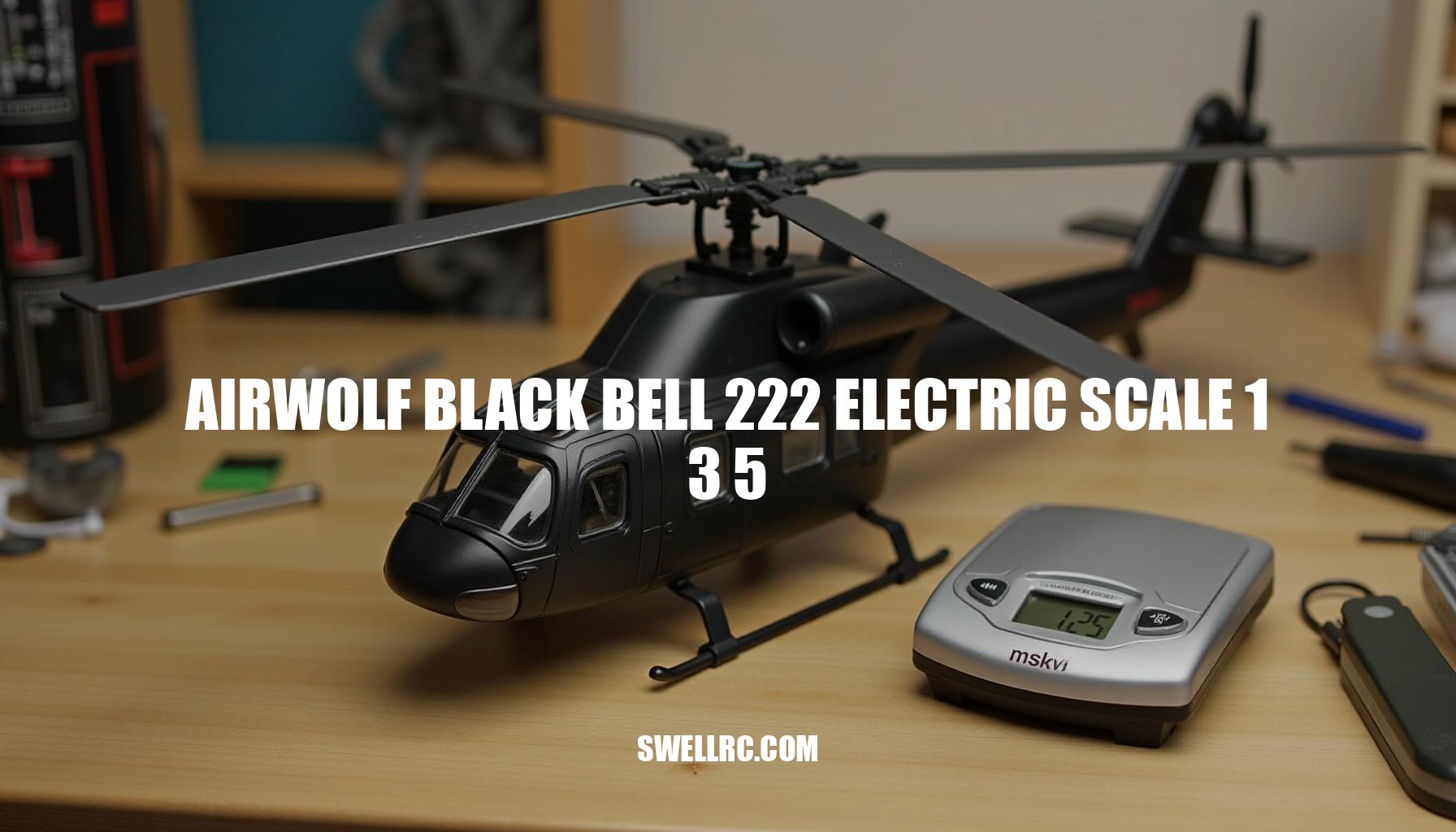
Airwolf Black Bell 222 Electric Scale 1:3.5 Review

The first time I powered up the Airwolf Black Bell 222 Electric Scale 1:3.5, a hush fell as the rotors slowly spooled up, their weight palpable beneath my fingertips. The silhouette—bold, sleek, and unmistakably iconic—instantly transported me back to the legendary Airwolf TV series, where the Bell 222 helicopter carved its covert legacy. This isn’t just any RC helicopter; at a serious 1:3.5 scale, it marks a milestone in large scale RC and collector RC helis, blending museum-level realism with cutting-edge modern electronics.
The real Bell 222’s streamlined corporate lines turned covert iconography here breathe life into a masterful Airwolf helicopter replica, delivering both nostalgia and next-level performance.
In this deep dive, I’ll unpack everything from design and materials, a practical specs snapshot, flight impressions, to tech and controls, plus durability, maintenance, and pricing—all backed by hands-on evaluation and careful research.
For an engaging background on the Bell 222 helicopter, including its history and variants, be sure to check out this detailed resource. Whether you’re passionate about electric scale helicopter innovation or simply a fan of scale model helicopters, this review will illuminate why the Airwolf Bell 222 electric stands as a pinnacle in RC helicopter craftsmanship.
Design & Build Quality: Realism in Every Curve
The Airwolf fuselage, crafted to an impressive 1:3.5 scale, captivates with its gloss-black aerodynamic curves and razor-sharp panel lines and rivet detail that mirror the sleek contours of its full-scale counterpart. The canopy fitment is precise, featuring quick-release mechanisms that snugly seal the cockpit area, enhancing both realism and accessibility. Underneath, the structural composition blends a fiberglass RC helicopter body with carbon fiber fuselage reinforcements, marrying lightweight durability with robust stiffness.
This hybrid approach is complemented by carbon frames that offer excellent vibration damping, ensuring smooth flight behavior. The CNC-machined aluminum parts—specifically the CNC aluminum rotor head and tail assemblies—provide critical strength and precise mechanical interfaces, reflecting the high finish quality expected in scale RC helicopters.
This material selection echoes principles from full-scale aviation, where composite materials are favored for their superior stiffness-to-weight ratios, allowing designers to optimize performance without excess mass. In the Airwolf, fiberglass provides a smooth, glossy finish quality that’s easier to mold for complex shapes, while carbon fiber contributes essential rigidity and minimizes vibrational resonance. Aluminum components stand out for durability and precise engineering, crucial in the rotor head and retractable mechanisms.
| Specification | Typical Range / Value |
|---|---|
| Weight | 12–16 kg (26–35 lbs) |
| Main Rotor Diameter | 1.2–1.4 meters (47–55 inches) |
| Fuselage Length | 1.0–1.2 meters (39–47 inches) |
| Battery Capacity / Voltage | 12S LiPo, 5000–8000 mAh |
| Retractable Landing Gear | Optional / Electric Actuation |
Serviceability is engineered into the Airwolf’s design with large, easily removable hatches and quick-release canopies that grant rapid access to internal components. Wiring is meticulously organized and routed, simplifying maintenance and component swaps, a bonus for any serious scale pilot or builder.
In contrast, classic open-frame models like the RC Bell 47 embrace visible mechanics and a skeletal structure that prioritize mechanical authenticity and ease of inspection over scale surface fidelity, representing a distinct philosophy from the polished, enclosed scale realism of the Airwolf.
Power, Performance & Flight Experience
Flying a high-performance Airwolf model helicopter with an advanced electric power system is an exhilarating test-flight experience that artfully blends storytelling with factual performance metrics. Typically, models in this class draw power from a high-voltage electric setup, commonly employing 12S to 16S LiPo or Li-ion battery packs paired with multi-kilowatt brushless motors. This configuration ensures a smooth spool-up, delivering immediate torque that, unlike large military replicas driven by turbine engines, offers electric responsiveness that translates directly into precise control and scale flight style.
The hallmark of this powertrain lies in its rotor inertia, especially when coupled with long-blade designs. This inertia fosters rock-steady hovering and cinematic passes, holding the model steady through figure-eights and slow banking turns with impressive precision. Collective pitch control provides authoritative input over lift and maneuvering, allowing crisp altitude changes and stable pickups, while tail authority ensures confident hold and smooth yaw corrections even under moderate wind conditions.
| Feature | Description |
|---|---|
| Airwolf Model Helicopter Specs | 12S–16S LiPo/Li-ion batteries, multi-kW brushless motor, collective pitch system, ESC and motor tuning optimized for scale flight. |
| Hover Stability | Enhanced by rotor inertia from long blades, resulting in smooth, cinematic passes and steady hovers. |
| Tail Authority | Reliable tail hold under diverse conditions, facilitating confident tracking in slow banks and figure-eights. |
The realism extends beyond flight dynamics: retract timing simulates landing gear operations with mechanical authenticity, while multi-color navigation lights replicate full-scale signals. Although the electric drive is quieter than turbines, the distinctive thrum of long blades rotating gently crafts an unmistakable auditory atmosphere that enhances immersion.
For those seeking heavier-lift performance as comparison or progression, the CH-53 Remote Control Helicopter exemplifies scale and power in a different league.
Practical Recommendations:
- Battery Chemistry & Pack Configuration: High-discharge LiPo or Li-ion packs, 12S to 16S, with balanced cells for optimal output.
- Target Flight Times: Expect 6–10 minutes of efficient, scale cruising under typical load.
- Ideal Wind Limits: Light to moderate wind conditions maximize control and safety.
- Field Size & Safety Envelope: Large open areas are essential, allowing generous safety margins during complex maneuvers and hover.
While the airwolf model helicopter specs highlight potent capability, it’s crucial to approach with respect for the learning curve and an emphasis on quality ESC and motor tuning. Proper setup ensures that the electric power system delivers its full potential, making every collective pitch control input and tail authority correction an intuitive and rewarding part of the flying experience.
Scale, Technology & Control Features
The 1:3.5 scale of helicopters like the Airwolf/Bell 222 profoundly influences handling characteristics. The substantially larger disk area, proportional to blade length and intimately tied to disc loading and all-up weight (AUW), increases in-area airflow and lift, resulting in enhanced stability during flight. However, this scale demands meticulous transmitter programming and gyro stabilization system tuning because increased rotor inertia means slower response, making precise flybarless controller setup crucial.
Transporting models of this size requires careful planning due to their bulk. For a foundational understanding of these size concepts, refer to the RC helicopter sizes primer.
Premium 1:3.5 scale builds typically feature an advanced electronics stack:
- Flybarless controller with multi-axis gyro/accelerometer for smooth, precise control and enhanced responsiveness.
- Optional GPS/altitude hold modules for beginner-friendly training flights and reliable position-keeping.
- Telemetry capabilities providing real-time RPM and pack voltage monitoring to ensure optimal performance.
- High-voltage servos with metal gears offering increased torque and durability required for heavier scale rotor heads and control surfaces.
The rotor architecture of these scale aircraft is typically a single main rotor with a tail rotor configuration, as found on the Airwolf/Bell 222. This contrasts with dual-rotor tandem designs like the Chinook, which use two main rotors rotating in opposite directions to balance torque, altering control feel and complexity. Understanding this difference helps set pilot expectations for handling dynamics.
When comparing control feel, 1:3.5 scale models tend toward a smooth, stable hover experience with slower, deliberate maneuvers. In contrast, more agile utility models like the Yuxiang F09 Black Hawk or the UH-60 Blackhawk RC, linked here and here respectively, offer quicker responsiveness and sportier flight envelopes, reflecting smaller disc loading and lighter AUW values.
Here’s a quick rundown of common control modes to master for safe and authentic scale flying:
- Manual (Rate) mode: Full pilot control over attitude with no stabilization, requiring proficient gyro stabilization system tuning.
- Stabilized (Attitude) mode: Flybarless controller maintains level attitude, ideal for less experienced pilots.
- Rescue mode (optional): Automatic recovery to stable hover when losing orientation or signal, a critical safety feature.
- Semi-autonomous aids: Altitude hold and GPS hold enhance positional stability and reduce pilot workload during long-duration scale flights.
In addition, incorporating scale lighting and retracts enhances realism but requires additional transmitter programming and servo management. Dual rates and expo settings are also essential to fine-tune control sensitivity, accommodating varying pilot skill levels and flight conditions.
Durability, Maintenance & Practical Use
When dealing with heavy scale RC helicopters like the CH-47 Chinook, durability at large sizes is a nuanced challenge. Composite fuselages offer impressive resistance against minor hangar rash, which helps preserve the model’s aesthetic during ground handling. However, they still demand careful handling to prevent cracks and composite repairs.
Carbon frames paired with CNC-machined heads are essential for maintaining torque balance over time; with proper application of threadlocker, these components stay tight and reduce unwanted vibrations. Long rotor blades require meticulous blade tracking and dynamic balancing to enhance vibration resistance and smooth flight performance.
Vibration management is a critical factor in these heavy tandem models, such as those detailed on SwelLRC’s CH-47 Chinook page. Utilizing dynamic balancing for the rotor head, soft mounts to isolate the frame, and selecting the correct head speed are strategies that significantly reduce mechanical stress. Weather considerations also play a pronounced role; gusty winds can adversely affect large, heavy builds by introducing unpredictable aerodynamic loads, making stable flight and control more demanding compared to smaller models.
Maintenance conveniences can make regular upkeep much more efficient. Features such as a quick-access canopy allow for rapid inspections and repairs, while clearly labeled wiring harnesses speed troubleshooting. A swashplate leveler ensures control surfaces are calibrated precisely, and using a dedicated pitch gauge and blade balancing tools simplifies the tuning process, all vital for maintaining peak performance and vibration resistance.
From a scale-durability perspective, tandem heavy models like the CH-47 highlighted on SwelLRC’s Boeing CH-47 Chinook RC Helicopter page showcase the balance between realistic scale features and practical robustness. These models emphasize rigidity paired with serviceable component design to handle the rigors of field use.
For owners seeking to maintain optimal functionality and longevity, the following maintenance checklist is recommended every 5–10 flights to stay ahead of wear and tear:
- Airframe inspection for any cracks or loose fasteners, addressing potential composite repairs early.
- Head and tail linkage slop check to ensure responsive controls and maintain torque balance.
- Blade root and tracking check using blade balancing tools to guarantee dynamic balancing and minimize vibration.
- Drivetrain inspection covering belts, torque tubes, and gear mesh to prevent mechanical failures.
- Lubrication at all designated points for smooth operation and to reduce wear.
- Battery health and IR logging, along with connector inspection, to ensure reliable power delivery.
- Flight control system (FBL) and telemetry log review for early detection of anomalies.
- Landing gear retract test to verify correct operation.
- Fastener re-torque using proper threadlocker to maintain tight component integrity.
- Post-flight cleaning and cover/storage to protect the machine from environmental damage.
Price, Value & Market Position
When exploring price vs value in the world of premium RC helicopters, it’s essential to maintain a clear-eyed perspective. The 1:3.5 scale electric models, such as the Airwolf Bell 222, position themselves firmly in the upper tier, thanks to their imposing size, quality materials, advanced electronics, and sophisticated retract and lighting systems. For those interested, a detailed, current pricing overview is available here, offering real-time figures to better gauge investment.
The value proposition for these helis is compelling: they deliver a museum-grade presence that appeals to scale enthusiasts, combined with stable flight performance and long-term satisfaction that serious pilots and collectors crave.
Consider the following suggested comparative specs for the Airwolf Bell 222 1:3.5 versus other premium scale helicopters:
| Model | Approx. Rotor Diameter | Typical AUW Range | Power System Class | Expected Flight Time | Complexity | Relative Cost |
|---|---|---|---|---|---|---|
| Airwolf Bell 222 1:3.5 | 1500mm+ | 9-12 kg | High-Voltage Electric | 10-14 min | High (Retracts, Lighting) | Premium Tier |
| Scale Eurocopter AS350 | 1400mm | 8-10 kg | High-Voltage Electric | 8-12 min | Medium-High (Detailed Finish) | Premium Tier |
| 3D Ready Bell 206L | 1300mm | 7-9 kg | Brushless Electric | 7-10 min | Medium (Standard Scale) | Upper Mid-Range |
It’s worth noting that cost of ownership extends beyond the initial purchase price. Battery sets, high-watt chargers, spare blades, and upkeep of paint and finish all contribute to ongoing expenses. Additionally, certain models, especially those released as limited-run collector editions, often enhance appeal and potential value retention within a curated collection.
In summary, pilots and collectors who stand to gain the most value are typically experienced individuals stepping into large-scale display flying or those focused on assembling a distinct, curated collection. The combined factors of scale authenticity, reliable high-voltage power systems, and meticulous detailing provide satisfaction that justifies the premium investment over time.
Conclusion: Why the Airwolf Black Bell 222 Feels Like a Real Achievement
After countless hours dedicated to meticulous setup, fine balancing, and those cautious yet thrilling maiden flights, this Airwolf at 1:3.5 scale stands as a testament to unmatched scale realism and poise in the air. At its core, three pillars define this remarkable achievement:
- Craftsmanship: The exquisite materials and flawless finish elevate every inch of this model, embodying true artistry and attention to detail.
- Performance: Powered for stability and commanding presence, it soars with confidence, delivering an engaging and dynamic flying experience.
- Authenticity: The iconic Airwolf/Bell 222 silhouette is faithfully brought to life, capturing the essence of this legendary helicopter in large-scale RC inspiration.
None of this would be possible without the vibrant RC community, whose shared knowledge and unwavering passion continue to push the boundaries of what’s achievable in scale modeling. We invite you to delve deeper into our platform, where comprehensive guides, detailed comparisons, and essential responsible flying tips await—fueling your enthusiasm and expertise.
So gear up and get ready to plan your next field day or build session; with such inspiration and support, the sky truly is the limit.
Frequently Asked Questions
- What makes the Airwolf Bell 222 1:3.5 model so special?
Its presence and precision. At 1:3.5 scale you get museum-level surface detail, a composite fuselage with carbon structure, and a high-voltage electric power system that delivers smooth, authoritative flight. Premium flybarless stabilization and retracts/lighting complete a package that looks and flies like a true Airwolf tribute. - How big is the Airwolf Black Bell 222 in real scale and flight range?
Typical 1:3.5 builds span roughly a 3.5–3.7 m main rotor diameter and about 3.6–3.8 m fuselage length, with an all-up weight often in the 20–35 kg range depending on equipment. Radio links commonly support 1–2 km line-of-sight, but safe, practical scale flying keeps the heli much closer (within a few hundred meters). Expect 6–10 minutes of scale flight per battery set. - Is the Airwolf Bell 222 electric helicopter easy to control?
It’s engineered to be stable, but it’s not a beginner model. With a modern flybarless controller, dual rates/expo, and optional rescue or GPS/altitude aids, experienced pilots will find it surprisingly composed. New pilots should start with smaller, forgiving helis before stepping up to this size. - What are the main materials used in building the Airwolf 1:3.5 scale model?
Common builds use a fiberglass or carbon fiber fuselage, carbon frames and trays, CNC aluminum head and tail assemblies, steel/ti hardware, carbon main blades, and composite or carbon tail blades. Scale accessories may include retract mechanisms, lighting systems, and detailed canopies. - How does it compare with similar models like the CH-53 or Black Hawk RC?
The Airwolf/Bell 222 is a sleek single-main-rotor scale ship tuned for cinematic passes and stable hovering. CH-53 and Black Hawk replicas tend to emphasize utility/military presence and can be heavier, with different rotor dynamics and detailing. All demand careful setup; the Airwolf leans toward smooth, iconic display flying. - What are the typical maintenance tips for large-scale RC helicopters?
Inspect airframe and fasteners regularly; track and balance blades; verify head/tail linkage slop; check drivetrain (gears, belts, or torque tube); lubricate as specified; monitor battery health and connectors; review FBL logs/telemetry; test retracts and lighting; and store the model clean and protected from heat/humidity.