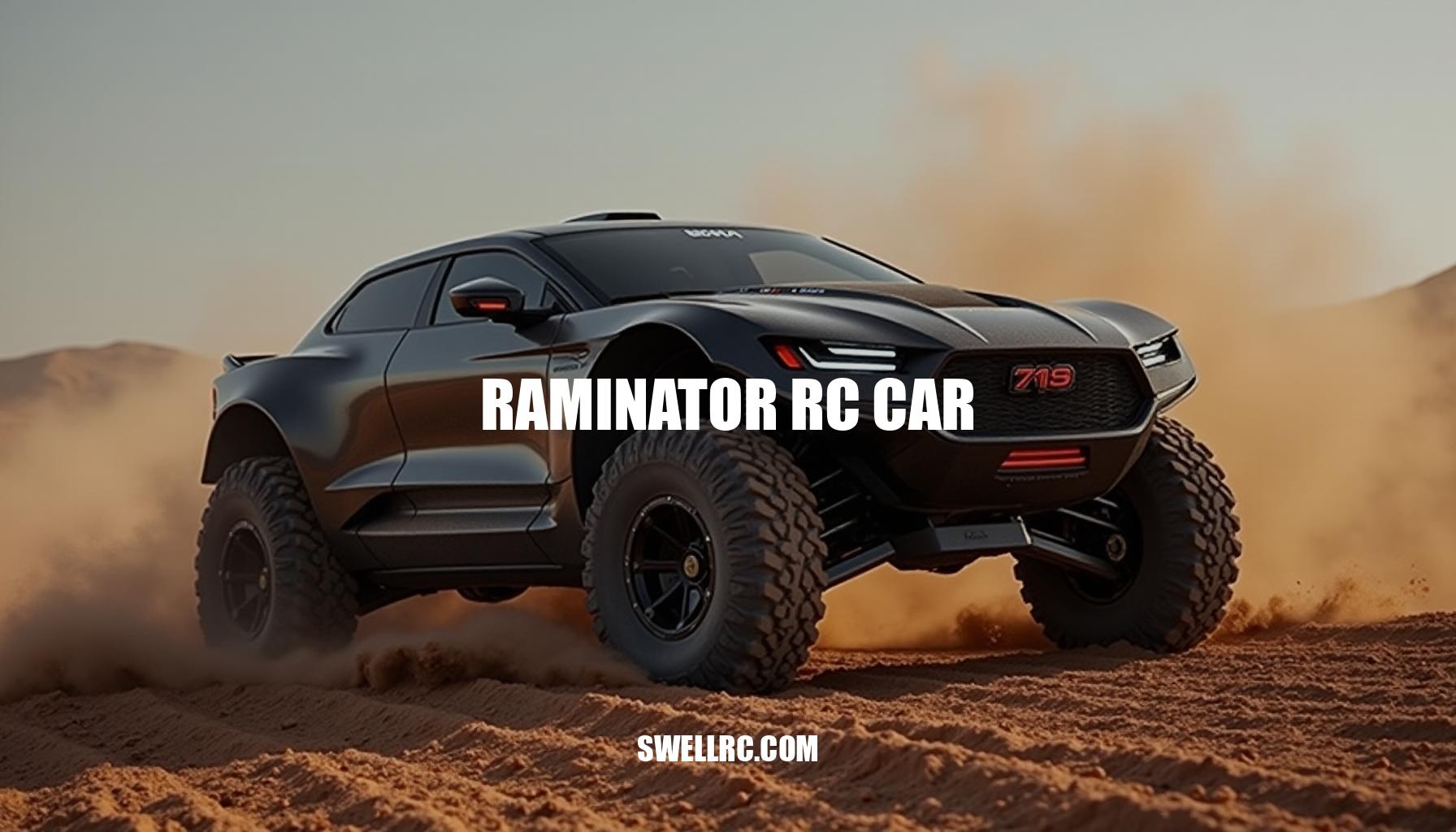
Raminator RC Car Review: Unleashing Monster Truck Power

The first time I saw a Raminator RC car thunder across a dirt lot, I felt it in my chest before I could process what my eyes were seeing. This isn’t just another monster truck RC car—it’s the poster child for large scale RC car madness, a gas-powered RC vehicle that completely rewrites what “scale power” means. Having been obsessed with big RCs for years, I quickly realized the 1/5 scale Raminator holds a legendary status among enthusiasts: it’s the one you hear before you see, the one people gather around.
That curiosity sent me down a rabbit hole—hours of runs, wrenching, and research—as I wanted to understand how this beast stacks up in RC car performance against lighter heavyweights like the Rovan RF5 or the fiery, high-revving contenders from the Nitro F1 RC scene. What I uncovered was a perfect blend of engineering spectacle and practical durability, proving the remote control truck isn’t just for show but built to dominate. In this first-person RC review, I’ll take you behind the scenes to reveal what’s under the shell and share how it drives in the real world, illustrating why the Raminator continues to be the benchmark for large-scale, gas-powered RC excitement.
Engineering Marvel: Under the Hood of the Raminator
If you’ve ever wondered why the Raminator 4WD RC truck commands such respect (and a premium price), the answer lies in its exceptional RC monster truck components and engineering durability. At the heart of this beast is a powerful 49cc engine RC that delivers roughly 4.5 to 5.0 horsepower in stock form, finely tuned for torque and longevity. This gas-powered heart makes it stand out from typical electric models, providing reliable power for extreme maneuvers.
Its drivetrain configuration features full-time 4WD equipped with robust steel driveline components and massive differentials engineered to handle the colossal load of this heavy-duty machine. Paired with gigantic tires, the Raminator provides unmatched traction and shock absorption, crucial for extreme off-road conditions.
The body materials include licensed monster truck shells crafted for durability and impact resistance, mounted on a heavy-gauge metal chassis with reinforced bracing. This ensures the truck can withstand harsh rollovers and aggressive driving stunts.
Equipped with a heavy-duty suspension RC setup, the truck boasts long-travel, oil-filled shocks and multi-link geometry designed to manage controlled compression and rebound. This advanced suspension equips the Raminator to conquer ruts, land hard jumps smoothly, and maintain stability over uneven terrain.
Here is a quick summary of the Raminator’s key specifications showcasing its superior build and performance:
| Specification | Details |
|---|---|
| Scale | 1/5 |
| Engine | 49cc 2-stroke gas (premix) |
| Power | ~4.5–5.0 hp (stock) |
| Drivetrain | Full-time 4WD |
| Weight | ~80–85 lb (36–39 kg) |
| Dimensions (L×W×H) | Approx. 40 × 26 × 24 in |
| Top Speed | Stock: ~22–25 mph; Gearing/pipe: 28–30+ mph |
| Fuel Mix | 2-stroke gasoline + oil (25:1 to 32:1) |
What truly stands out is the perfect balance between its components — the drivetrain configuration manages the colossal mass with ease, the heavy-duty suspension RC soaks up brutal abuse, and the 49cc engine RC prioritizes torque, essential for a real monster truck experience. This combination makes the Raminator an unparalleled performer valued by serious enthusiasts who demand engineering durability and heavyweight capability.
Real-World Performance: Putting the Raminator to the Test
I ran the Raminator across three proving grounds—packed dirt, rough asphalt, and a steep hillside—to separate hype from reality in a real-world RC test that highlights torque and power comparison as well as RC handling at speed.
On dirt, it squats, hooks, and goes. The torque is immediate, and the weight keeps it planted. Roosts are huge, steering is deliberate but predictable, showcasing monster truck RC performance at its best.
On asphalt, it’s loud, straight-line stable, and surprisingly composed at mid-to-high speeds. You feel the mass under braking—smooth inputs reward you, illustrating refined RC handling at speed.
Hill climbs are where the torque shines brightest. It grinds upward with throttle control; throttle blips help it crest without unloading the rear, demonstrating powerful torque and control in rugged terrain.
Compared with cheap RC cars that go fast (cheap RC cars that go fast), the difference is night and day. Speed alone isn’t the story—control, recovery, and durability are equally critical. “Fast” is fun; “fast and unstoppable over bad terrain” is a different sport, emphasizing durability testing and true monster truck RC performance.
Efficiency and upkeep are paramount for an optimal gas-powered RC runtime experience. Here’s a quick overview:
- Runtime: 20–35 minutes per tank depending on terrain and throttle discipline, reflecting efficient gas-powered RC runtime.
- Maintenance: Keep the air filter clean, inspect the clutch, check chain or belt tension and differential fluids, and Loctite critical hardware, following essential RC maintenance tips.
| Feature | Details |
|---|---|
| Speed | Stock mid-20s mph; with pipe and gearing upgrades, nudges 30 mph. |
| Noise | Classic 2-stroke bark—ear protection recommended. |
| Durability | Designed to absorb crashes that would fold lighter rigs, an important aspect of durability testing. |
| Learning Curve | Respect the mass; smooth inputs equal smooth results, essential for mastering monster truck RC performance. |
Raminator vs The Field: Comparing Heavyweights
Choosing the right RC monster truck for your needs involves understanding your priorities—whether you value torque, transportability, precision, or price. In this RC monster truck showdown, we compare some of the best large-scale RC cars on the market, highlighting their strengths in a detailed torque and power comparison and overall performance.
| Model | Scale/Type | Torque & Power | Transportability | Specialty | Price & Convenience |
|---|---|---|---|---|---|
| Raminator | 1/5 gas | Unmatched torque & impressive suspension travel | Heavier, less convenient to transport | Dominates big terrain, presence, and durability | Pricier and heavier to move |
| Rovan RF5 | 1/5 gas | Strong but less brute-force torque than Raminator | Lighter platform, easier transport | Quicker direction changes and agility | Better balance of power and convenience |
| Storm RC Car | Value-focused basher | Fun and capable but smaller engine and mass | Compact and easy to handle | Great entry-level and casual driving | Budget-friendly |
| RC Nissan Patrol | Scale crawler | Less focus on speed and torque | Engineered for technical terrain | Supreme technical driving and realism | Not suitable for high-speed bashing |
| Professional RC Cars | 1/8 brushless or nitro | Precision handling on track | Lighter and designed for track performance | Race-bred surgical handling, not off-road spectacle | Focused on competition, less on durability vs agility tradeoff |
The large scale RC car comparison clearly shows where each vehicle shines. The Raminator stands alone in raw torque, suspension travel, commanding presence, and durability over big, unruly terrain. Conversely, lighter models like the Rovan RF5 excel in durability vs agility, offering superior handling on tighter courses and easier transport convenience.
For buyers fascinated by monster-truck theatrics and who have the space to accommodate it, the Raminator is truly in a class of its own. Whether you prioritize earth-shaking power or nimble precision, this overview helps guide your choice in the diverse world of 1/5 scale gas RC vehicles and beyond.
Beyond the Beast: The Raminator Community and Culture
The best part of owning a Raminator is undoubtedly the Raminator community it brings together. I gained more knowledge in just two weeks by immersing myself in local bash spots, regional monster meetups, and online groups where build logs and tuning notes flow daily than from months of solo tinkering. These large-scale RC events not only foster strong connections but also offer a wealth of insights into RC customization and aftermarket mods.
Adjacent niches such as micro madness with RC pocket racers (RC pocket racers) and high-speed lane discipline in RC F1 Nitro (RC F1 Nitro) contribute to the vibrant RC culture by exchanging ideas that enhance tuning upgrades and techniques.
Popular modifications and tuning upgrades among enthusiasts include:
- Tuned pipe and gearing changes for increased top-end speed
- Steering servo torque upgrades and installing metal horns for better control
- Heavy-duty clutch, spur gears, and driveline parts to boost durability
- Beadlock wheels, specialized tire foams, and reinforced body mounts for rugged performance
The community also shares invaluable repair tips and recommendations:
- Best first mod: upgrading the air filter and tuning the carburetor properly
- Reliability tip: routinely inspecting chain and belt tension after each bash day
- Setup secret: balancing shock oil weights front-to-rear to adapt to terrain variations
- Favorite content types: detailed long-form build series and durability tests accompanied by crash analysis
Engaging with the Raminator community enhances every aspect of your RC experience—from fine-tuning performance with aftermarket mods to learning practical repair tips that keep your rig running at its peak during all those exhilarating large-scale RC events.
The Power Price: Why the Raminator Costs What It Does
Sticker shock fades once you consider what goes into the Raminator price—a true 1/5-scale, gas-powered monster truck. The RC cost drivers here include licensed bodies, low-volume manufacturing, CNC and steel components, massive tires, heavy hardware, and freight shipping due to the truck’s sheer size and weight. Notably, the engine dwarfs those found in smaller rigs, underscoring the gas-powered RC economics at play.
For context, some of the most expensive RC car models can soar well beyond the Raminator’s price tag, often driven by exotic materials or extremely limited runs.
However, with the Raminator, you’re investing in solid durability value, immense torque, and tangible heft that you can feel with every pull of the cord.
Is it worth it?
- For dedicated enthusiasts craving monster-truck realism, huge-terrain capability, and a platform rewarding fine-tuning, the large-scale RC investment translates to undeniable value.
- If transport, storage, or noise are deal-breakers, a lighter electric or smaller-scale gas model might serve you better.
My take: The Raminator price reflects genuine performance and quality materials rather than extravagance—it’s a serious machine designed for serious fun.
Conclusion: The Raminator RC Car Legacy
After countless runs, busted knuckles, and those unavoidable late-night tuning sessions, I finally grasped why the Raminator legacy continues to inspire such devotion among monster truck enthusiasts. This isn’t just any RC; it delivers a monster truck RC experience that feels truly alive—heavy, roaring loud, and packed with torque—yet it’s engineered to withstand relentless punishment with a smile. The RC value proposition here is crystal clear: if you’re hungry for authentic, large-scale raw power and spectacle in your remote-controlled vehicle, the Raminator sets the definitive benchmark.
- Power and torque that effortlessly transform rough terrain into an exhilarating playground
- Precision engineering that skillfully balances brute force with reliable durability
- A passionate community that ensures the journey is as thrilling as the destination
| Who Should Buy the Raminator |
|---|
|
The Raminator is perfect for enthusiasts eager to immerse themselves in the most visceral, large-scale RC thrill available today. If you desire a jaw-dropping spectacle paired with raw power, this monster truck RC experience is unmatched. However, if you’re chasing precision lap times and professional-grade RC racing, numerous other highly specialized platforms might better suit your needs. But for sheer dominance in scale and force, the Raminator stands tall above the rest. |
Frequently Asked Questions
- How fast does the Raminator RC car go?
In stock trim, expect roughly 22–25 mph. With a tuned pipe and gearing changes, many owners see about 28–30+ mph on suitable terrain. - What scale is the Raminator RC truck?
It’s a 1/5-scale monster truck—physically massive compared to typical 1/10 or 1/8 rigs. - Is the Raminator RC worth the price?
If you want true monster-truck size, torque, and durability, yes. You’re paying for low-volume, heavy-duty engineering and a 49cc gas powerplant. If portability or noise are priorities, a smaller electric model may suit you better. - What engine does the Raminator RC use?
A 49cc 2-stroke gasoline engine (premix), built for high torque and long service life. Many owners add a tuned pipe for extra performance. - How heavy is the Raminator RC car?
Approximately 80–85 pounds (about 36–39 kg), depending on configuration and accessories. - How does the Raminator compare to other monster RC trucks like the Rovan RF5?
The Raminator prioritizes torque, suspension travel, and sheer presence; it’s heavier and more stable over rough terrain. The Rovan RF5 is lighter and more agile, easier to transport, and typically more responsive in tight areas. - Can beginners handle the Raminator RC car?
Yes—with respect. Start in open areas, use smooth throttle and braking, and learn maintenance basics. Its mass demands careful inputs, but it’s predictable and robust. - What makes the Raminator one of the most powerful RC trucks ever built?
A 49cc gas engine, heavy-duty 4WD drivetrain, long-travel suspension, and components scaled for real punishment. It delivers torque and presence few RCs can match.